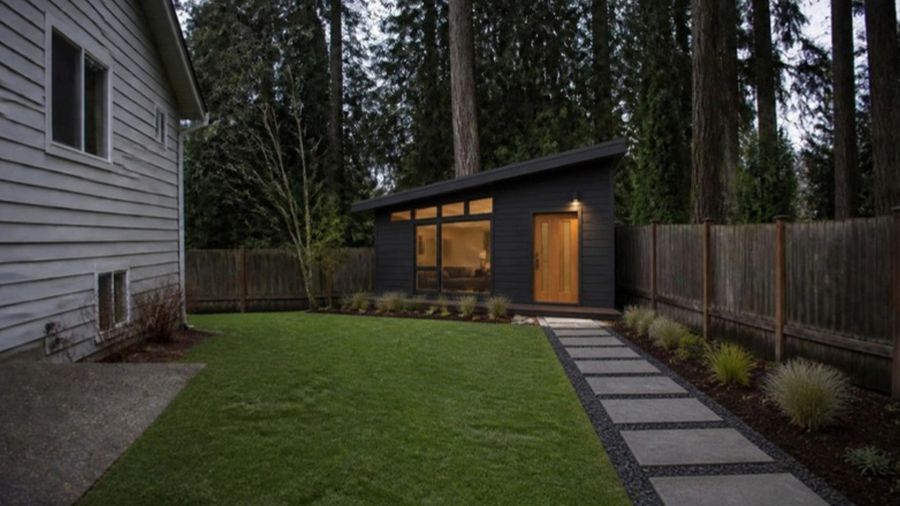
Her own front door, thirty steps from yours.
A detached second home on the lot you already own. Since 2023 Washington cities inside urban growth areas must allow up to two accessory dwelling units per lot, with no requirement that you live on the property — and the second unit can be sold as its own condominium.
Nobody does this for the square footage.
Close for Sunday dinner, separate every evening
The alternative is $6,975 a month in assisted living, or a spare room that was never really spare.
A first place that isn't across the state
57% of 18-to-24-year-olds live with their parents. A second home buys everyone back their privacy.
Rent that helps carry the mortgage
A one-bedroom in Everett rents for a median $1,545 a month. What yours could earn depends on your lot and your city.
A separate address you can sell
State law now lets many cities' ADUs be sold as condominium units. Whether it works on your lot depends on your city, your lender and your title company.
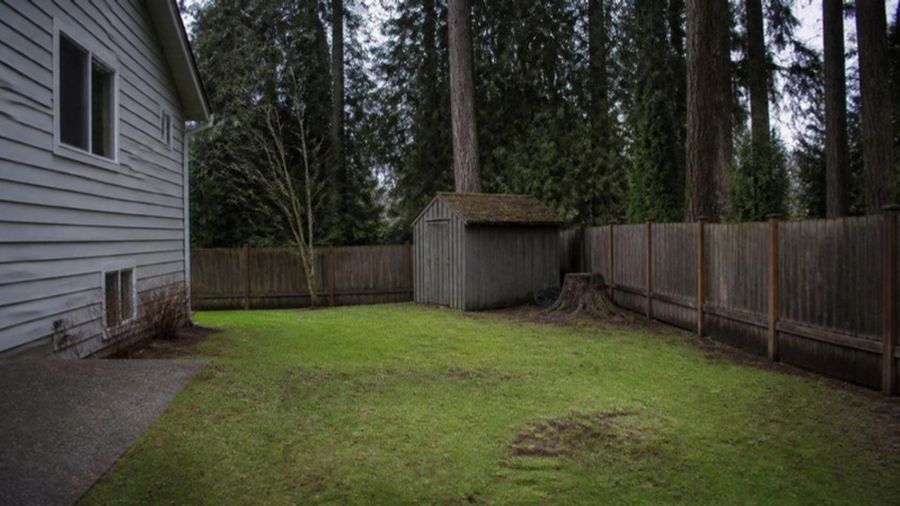
Illustration, not a rendering of your property. What actually fits on your lot depends on its size, shape, setbacks, utilities, trees and your city's rules — which is exactly what the report works out.
Your city's ADU rules, applied to your parcel.
From public records
Zoning and the ADU standards your city adopted after HB 1337 — how many units, maximum size, height, setbacks, lot coverage, parking, whether owner-occupancy is required (it usually isn't now), and whether a condominium sale is allowed. Then the parcel itself: lot area and shape, the existing footprint, what's left after setbacks, mapped flood, wetland, slope and soil flags, and whether sewer or septic serves the address.
Only on site
Whether a concrete truck and a crane can reach the back of the lot, the health of the trees the code protects, the real condition of the sewer lateral, easements that aren't of record, and what your HOA's covenants say. The report names each of these plainly on page four, and a site visit settles them before anything is proposed.
Roughly 400 to 1,200 square feet. Seven to fourteen months.
The report models three size bands — a compact one-bedroom, a two-bedroom, and a larger two-story — and gives an all-in planning range for the one that fits your lot, with each rate sourced and dated. Recent proposals in this region for comparable homes have run from about $293,000 for a compact unit to the mid-$400,000s for a two-bedroom, two-story home; every proposal excludes permits, utility connection fees and Washington sales tax, and a fixed price comes only after a survey, a site visit and a design.
Design through move-in generally runs seven to fourteen months in this market, with permit review the least predictable part. No timeline on this site is a commitment.
Price examples are working figures from 2026 proposals; HousUp's published price list follows when the builder of record is confirmed. Construction is by [Builder of record — pending], WA contractor reg. [WA contractor reg. no. — pending].
Questions people ask about backyard homes
Do I have to live on the property?
In most Washington cities, no — HB 1337 removed owner-occupancy requirements for cities inside urban growth areas. Your report says which rule your city actually enforces; one or two are still catching up.
How big can it be?
Cities may not cap an ADU below 1,000 square feet under state law, and many allow more. Your lot's setbacks and coverage usually decide it before the cap does.
Can I sell it separately?
State law bars cities from prohibiting condominium sale of an ADU. It still takes a survey, a condominium declaration, a cooperative lender and a title company — the report tells you whether your city and lot make that a realistic path.
Find out what fits on your lot.
One page, two minutes. Your report within the hour.